For the week of Monday, December 18, 2023.
On December 18, 1901, a protest meeting at Indian Head, Saskatchewan, led in part by W. R. Motherwell (1860–1943), resulted in the formation of the Territorial Grain Grower’s Association. The first farm advocacy organization in Western Canada, it represented the interests of ordinary farmers seeking fairer terms from monopolistic and discriminatory grain elevator corporations and the Canadian Pacific Railway. Motherwell served as president and travelled the region, encouraging other farmers to form their own chapters.
Motherwell left Lanark County, Ontario, for the Canadian West in 1882, at a time when many Euro-Canadians were moving to the prairies. Due to the influence of the Homestead Act/Dominion Lands Act and newly established treaties, he was able to place claim on one quarter section (65 hectares or 160 acres) near Abernethy, north of the Qu’Appelle Valley of what would become the province of Saskatchewan in 1905. Located in Treaty 4 Territory, the region was part of the Pheasant Plains district, where the Nêhiyawak (Plains Cree), Nahkawininiwak (Saulteaux), Dakota, Nakota, and Métis were the original inhabitants and stewards of the land.
An agricultural reformer and activist, Motherwell set about establishing a model farmstead, which incorporated designs prescribed by advocates of scientific agriculture. For example, he planted a shelter belt (barriers of trees and hedges) to protect the property from wind. He also divided his stead into orderly quadrants, in which different farm and household activities occurred. As well, he excavated a dug out and installed a filtration system for an abundant fresh water supply.
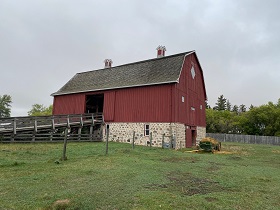
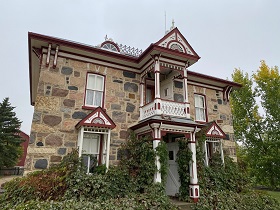
In 1897, Motherwell hired a mason to construct a square two-storey stone house with kitchen ell (a subsidiary wing of a building perpendicular to the length) in a fashionable style. This was an unusual though durable building material choice in prairie regional architecture. Over two phases in 1896 and 1907, he also built a large L-shaped, gambrel roof barn with fieldstone cellar. It employed many labour-saving strategies, such as chutes to distribute fodder from the granaries and mow on the main floor to the livestock housed in the cellar below.
From his well-designed farmstead in Abernethy, Motherwell became a leading figure in progressive agriculture in Western Canada. He promoted innovative dryland farming techniques for cultivating the prairies and spurred a regional cooperative movement that encouraged farmers to work together to effect change. Given his strong lobbying skills, he entered provincial politics with an interest in advancing agricultural issues, serving as Minister of Agriculture at both the provincial (1905–1918) and federal (1921–1929) levels. He also helped establish Saskatchewan’s agricultural college.