
For the week of November 27, 2023
On November 28, 2005, the Government of Canada recognized the establishment of the Commercial Bush-Flying Industry in Canada as a national historic event. Laurentide Air Service Ltd. and other early bush-flying companies were crucial to regional economic growth, the introduction of aerial photography and mapping, and the development of new transportation networks in Northern Canada.
The First World War (1914–1918) saw significant technological advancements in aviation and the training of more than 7,000 Canadians as pilots, observers, and mechanics in the British Royal Flying Corps (later the British Royal Air Force). This laid the foundations for the development of civil aviation in postwar Canada, with private businesses leading the way.
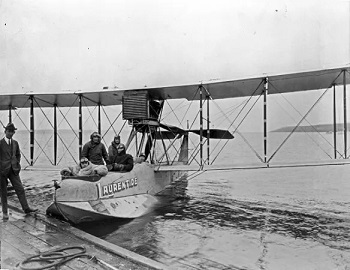
Bush flying began in Canada when the Maurice region of Quebec was plagued by massive forest fires in 1919. The Laurentide Company was one of the many paper mills that saw the potential of aircraft in detecting forest fires before they grew out of control. Instead of patrolling by foot or canoe, it would now be possible to survey forested areas from above. In 1919, Ellwood Wilson, the Chief Forester for the Laurentide Co., partnered with the St. Maurice Forest Protective Association (SMFPA). Together, they acquired two Curtiss HS-2L aircraft. These flying boat biplanes were American anti-submarine aircraft, designed in 1917 and used by the United States during the First World War. Their ability to land on small bodies of water made them ideal for bush flying.
Stuart Graham, an American-born veteran of the Canadian Army who served in the British Royal Air Force, heard that the SMFPA was looking for a forest fire patrol pilot and offered his services. On June 5, 1919, he flew the first Curtiss HS-2L (La Vigilance) from Halifax to Lac-à-la-Tortue in Quebec, with his wife Madge as navigator and engineer Bill Kahre. The flight took three days and is the longest bush flight across Canadian territory at the time. On July 7, Graham conducted his first reconnaissance mission on La Vigilance of a forest fire along the Croche River. The success of this experiment led to the establishment of the first civilian seaplane base, at Lac-à-la-Tortue, and the creation of a small bush flying company to provide air services for the St. Maurice Forest Protective Association. The seaplane base became the Laurentide Co. in 1920 and Laurentide Air Service Ltd. in 1922. For the first several years, Graham was the sole pilot in the bush flying operation run by Laurentide Co.
Over the next five years, the Laurentide Co. spent thousands of hours in the skies over northern Ontario and Quebec on a wide range of missions. In the autumn of 1919, it introduced aerial photography to provide valuable topographical and ecological information. It was employed in 1920 to investigate a spruce budworm epidemic. The Laurentide Air Service Ltd., as it was known by 1922, detected more than 400 forest fires in one season. In 1923, it received contracts from the Ontario provincial government for mapping work. The following year, it diversified to support gold mining in Abitibi and to provide an airmail service.
The establishment of the Ontario Provincial Air Service in 1924 meant the Laurentide Air Service Ltd. no longer received government contracts and, by 1925, it had ceased operations. However, the bush-flying instruction manual it created the year before continued to be used. A first of its kind in Canada, it ensured that the knowledge and skills gained through this early venture in commercial aviation was not lost.
The Establishment of the Commercial Bush-Flying Industry in Canada was designated as a national historic event in 2005. The Historic Sites and Monuments Board of Canada (HSMBC) advises the Government of Canada on the commemoration of national historic events, which evoke significant moments, episodes, movements, or experiences in the history of Canada.
The National Program of Historical Commemoration relies on the participation of Canadians in the identification of places, events, and persons of national historic significance. Any member of the public can nominate a topic for consideration by the Historic Sites and Monuments Board of Canada. Learn how to participate in this process.