
For the week of Monday, October 30, 2023.
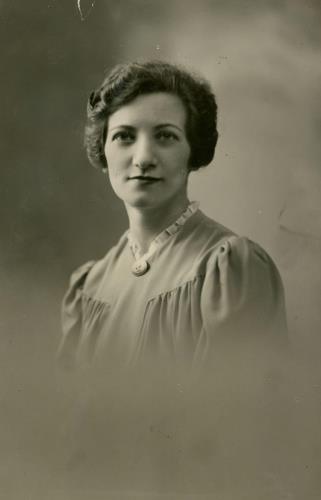
On November 3, 1903, Léa Roback was born in Montréal to Fanny and Moses Roback, Jewish Canadians who had immigrated from Poland. She would go on to become a social activist and labour organizer, dedicated to fighting injustices and inequalities, and making life in Canada better for all.
Roback spent much of her childhood in Beauport, northeast of Québec City. There, her father worked as a tailor and her mother ran a general store until 1915, when the family returned to Montréal, Quebec. As a teenager, she worked as a receptionist at the British American Dyeworks and later as a cashier for Her Majesty’s Theatre on Guy Street. She left Montréal in 1926 after saving up enough money to study literature at the Université de Grenoble in France and work as a tutor to pay her tuition. After graduating with a Bachelor of Arts, she travelled to New York City before joining her brother in Berlin, Germany, in 1929, where she continued her university studies and taught English.
Roback began her activism in Berlin, protesting against Nazism and joining the Communist Party in 1929. She left Germany in 1933, visiting the Soviet Union and the United States before returning to Montréal in 1934. Over the next two years, Roback supported the campaign of Fred Rose, the first Communist Party candidate elected to the Canadian House of Commons; she joined forces with Thérèse Casgrain to advocate for Quebec women’s right to vote; and she was put in charge of the Modern Book Shop on Bleury Street, one of the first Marxist bookstores in Quebec and a gathering place for local radicals.
Beginning in 1936, Roback began working with Rose Pesotta of New York to bring the International Ladies Garment Workers Union (ILGWU) to Montréal. Founded in New York in 1900, this union initially represented a largely Jewish American workforce. Roback worked as a liaison between Pesotta and workers in Montréal, many of whom were French Canadian women. Roback and Pesotta led the unionization of these workers and negotiated on their behalf with the factory owners of the Dressmakers’ Guild.
While a few proprietors signed agreements with the union most refused, and the union was forced to strike. The Montréal Dressmakers’ Strike of 1937 involved up to 5,000 women and lasted three weeks, between April 15 and May 7. During the strike, the non-Jewish dress manufacturers stirred up antisemitism to try to keep French Canadian workers away from the Jewish dressmakers and the Jewish-led ILGWU. This ploy did not work, despite the prevalence of antisemitism in Quebec during the Great Depression of the 1930s. The strike proved to be a definitive victory for labour activism in Montréal, as it resulted in better wages, shorter workdays, and official recognition of the union. Roback continued to advocate for social justice in the years that followed and received many honours, including the title of Knight of the Ordre national du Québec in 2000, shortly before her death.
The Montréal Dressmakers' Strike of 1937 was designated as a national historic event in 2007. The Historic Sites and Monuments Board of Canada (HSMBC) advises the Government of Canada on the commemoration of national historic events, which evoke significant moments, episodes, movements, or experiences in the history of Canada.
The National Program of Historical Commemoration relies on the participation of Canadians in the identification of places, persons, and events of national historic significance. Any member of the public can submit a subject to the Historic Sites and Monuments Board of Canada. Learn how to participate in this process.