For the week of Monday October 23, 2023.
On October 23, 1969, the Government of Canada designated the Inuksuk of Inuksugalait (Inuksugasalik or Enusko Point) as a national historic site. The site at Inuksugalait encompasses many Inuksuit (also spelled inukshuk; singular inuksuk). These are carefully crafted cairns, in a variety of shapes and sizes, which tell stories of Inuit culture. They serve many purposes, including as markers that provide direction, indicate a spiritual presence, direct the movement of animals, or commemorate an important event.
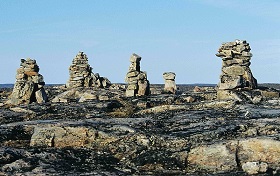
Inuksugalait is located approximately 88.5 kilometres from Kinngait (Cape Dorset) in Nunavut on the Foxe Peninsula of Baffin Island. Stone structures have been an integral part of arctic cultures since before the arrival of Neo-Inuit, the ancestors of the present day Inuit, who migrated east from the Western artic around the end of the 12th century. In the treeless, rocky landscape of Inuksugalait, there stands nearly a hundred cairns that vary widely in age, style, and size, with some as tall as two metres.
Inuksuit serve several purposes, ranging from practical to spiritual, and these change over time. They represent ancestral knowledge of the land. Inuksuit are land markers that have been essential to Inuit life, and usually built around good spots for fishing or hunting seal and caribou. Outside of indicating food sources, inuksuit are also built by hunters to warn future travellers of potential dangers. They are important structures to Inuit culture and are never knocked down.
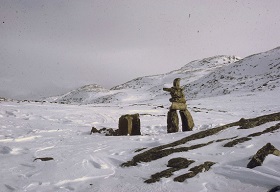
To build an inuksuk, each rock is carefully selected and assembled like a three-dimensional puzzle to form a rock sculpture. There are many variations of inuksuit. There is often a window to look through, which directs the gaze to a good hunting spot. Sakamaktat are tall cairns, which Inuit ancestors used to keep meat safe from hunting dogs. Tikkuuti have a long pointing horizontal rock on top that helps travelers find their way. Inunnguaq are human-shaped and used to mark a tragedy. Others serve a spiritual purpose, indicating the location of a site of ceremonial value. All inuksuit are objects of veneration, and many Inuit and places are named after them. The inuksuit that stand today are a reminder of Inuit’s ancestral connection to the land.
In recent years, non-Inuit have often used inunnguaq as a symbol of northern Canada but, unlike traditional inuksuit, they do not represent the continuity of Inuit culture across millennia.
On October 23, 1969, the Government of Canada designated the Inuksuk of Inuksugalait (Inuksugasalik or Enusko Point) as a national historic site. The site at Inuksugalait encompasses many Inuksuit (also spelled inukshuk; singular inuksuk). These are carefully crafted cairns, in a variety of shapes and sizes, which tell stories of Inuit culture. They serve many purposes, including as markers that provide direction, indicate a spiritual presence, direct the movement of animals, or commemorate an important event.
Inuksugalait is located approximately 88.5 kilometres from Kinngait (Cape Dorset) in Nunavut on the Foxe Peninsula of Baffin Island. Stone structures have been an integral part of arctic cultures since before the arrival of Neo-Inuit, the ancestors of the present day Inuit, who migrated east from the Western artic around the end of the 12th century. In the treeless, rocky landscape of Inuksugalait, there stands nearly a hundred cairns that vary widely in age, style, and size, with some as tall as two metres.
Inuksuit serve several purposes, ranging from practical to spiritual, and these change over time. They represent ancestral knowledge of the land. Inuksuit are land markers that have been essential to Inuit life, and usually built around good spots for fishing or hunting seal and caribou. Outside of indicating food sources, inuksuit are also built by hunters to warn future travellers of potential dangers. They are important structures to Inuit culture and are never knocked down.
To build an inuksuk, each rock is carefully selected and assembled like a three-dimensional puzzle to form a rock sculpture. There are many variations of inuksuit. There is often a window to look through, which directs the gaze to a good hunting spot. Sakamaktat are tall cairns, which Inuit ancestors used to keep meat safe from hunting dogs. Tikkuuti have a long pointing horizontal rock on top that helps travelers find their way. Inunnguaq are human-shaped and used to mark a tragedy. Others serve a spiritual purpose, indicating the location of a site of ceremonial value. All inuksuit are objects of veneration, and many Inuit and places are named after them. The inuksuit that stand today are a reminder of Inuit’s ancestral connection to the land.
In recent years, non-Inuit have often used inunnguaq as a symbol of northern Canada but, unlike traditional inuksuit, they do not represent the continuity of Inuit culture across millennia.