
For the week of Monday, October 2, 2023.
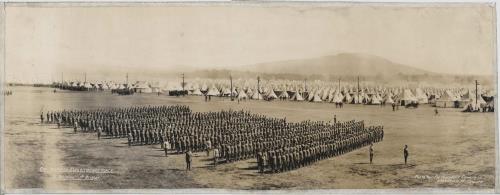
On October 3, 1914, just a few months after the First World War (1914–1918) began, 30,617 troops of the First Canadian Contingent left Valcartier, Quebec, for England. They sailed as part of convoy of 30 ocean liners, escorted by the British Royal Navy.
When Britain declared war in August 1914, Canada was automatically at war, too, as it was a dominion of the British Empire. At the time, Canada had a small standing army of about 3,100 soldiers and a part-time militia of more than 110,000 men (active and inactive). To bolster the ranks, Prime Minister Sir Robert Borden called for the creation of a Canadian contingent of 25,000 men. The minister of militia, Sir Sam Hughes, agreed, and issued a general call to arms. Hughes believed, like many Canadians, in the militia myth, which credited local militiamen with the defence of British North America during the War of 1812. While this myth ignored the significant roles played by British regulars and allied First Nations, turning to citizens to form this new army was essential because of Canada’s weak professional force.
Within a few weeks, more than 35,000 Canadians between 18 and 45 years old had volunteered for military service, as well as many underage boys and overage men. Not everyone was accepted. There was no citizenship requirement in 1914, but recruiting offices turned away men who were born in the enemy Central Powers of Germany, Austria-Hungary, Bulgaria, and the Ottoman Empire. Other men, especially those of African, Asian, and Indigenous descent, were often turned away in the early days of the war because of racism, although thousands would later serve in uniform.
On August 24, roughly three weeks after the British declaration of war, the first recruits arrived at Valcartier Camp near Québec City. The camp was hastily assembled, made up mostly of tents on an open field, with few permanent buildings. Despite the cold nights and heavy rains, they engaged in marching, training, and drill. Canada struggled to outfit them with proper military gear and weaponry: there was a shortage of uniforms, boots were of poor quality, and the Canadian-made Ross Rifles would later jam in battle. However, no preparation or training could prepare them for the realities and horrors of trench warfare.
This force of infantry, artillery, cavalry, and supporting units sailed for England in October. Upon their arrival, the thousands of Canadians were greeted by cheering crowds who thanked the “new world” soldiers arriving from the Dominion. After disembarking at Plymouth, the force travelled seven hours by train to set up camp on Salisbury Plain. Over the winter, they received further training in the harsh conditions of deep mud and withering cold. But the new formation to emerge—the Canadian Division—learned to soldier. By February 1915, it was fighting on the Western Front in Belgium, where it received its baptism of fire at the Second Battle of Ypres in April 1915. There, amid enemy shells, bullets, and chemical weapons, the Canadians fought with courage and skill but paid a terrible price with more than 6,000 casualties.
Sir Samuel Hughes was designated as a national historic person in 1969. The Historic Sites and Monuments Board of Canada (HSMBC) advises the Government of Canada on the commemoration of national historic persons—individuals who have made unique and enduring contributions to the history of Canada.
The National Program of Historical Commemoration relies on the participation of Canadians in the identification of places, persons and events of national historic significance. Any member of the public can submit a subject to the Historic Sites and Monuments Board of Canada. Learn how to participate in this process.