For the week of July 10, 2023.
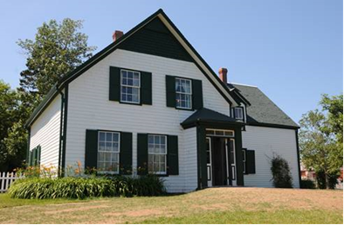
On July 10, 1985, the Government of Canada designated Green Gables House in Cavendish, Prince Edward Island, as a Recognized federal heritage building. This farmhouse was an inspiration for the fictional home of Anne Shirley in the classic novel, Anne of Green Gables (1908). One of the best-known literary landmarks in the world, Green Gables House is visited by hundreds of thousands of devoted fans each year.
The farmhouse was built in stages between the 1830s and 1870s for the Macneill family, and a 2nd floor over the kitchen was added in 1914. It consists of a main wing, which is a refined space with its formal sitting and dining rooms. There is also a large adjacent kitchen ell wing, where the Macneills cooked, processed milk, and performed other farm duties. A long timber-framed barn, a granary and a woodshed, since recreated, are located beside and behind the house, creating a farmyard.
The Macneills were maternal cousins of Lucy Maud Montgomery (1874–1942), the famed author of Anne of Green Gables. Montgomery resided close to Green Gables, on the farm of her grandparents. It was here she began her literary career, discreetly mailing dozens of short stories and poems to publishers from the family-run post office. The publication and immediate success of Anne of Green Gables in 1908 set her on a path towards international stardom. Montgomery often drew upon the rural vernacular architecture and landscape of Prince Edward Island to create her fictional worlds; only one of her novels is set beyond the Island.
By the 1920s, the family of Myrtle (Macneill) Webb was living at Green Gables and renting out rooms to literary pilgrims. Parks Canada acquired the property in 1937, as part of the newly established Prince Edward Island National Park, and began running a tearoom in the house, alongside the lodgings for visitors. After the Webbs moved out in the mid-1940s, Parks Canada changed the house to better fit the expectations of fans of Anne of Green Gables: they painted the gables green and added wide shutters, which were not characteristic of houses owned by farming families on the Island.
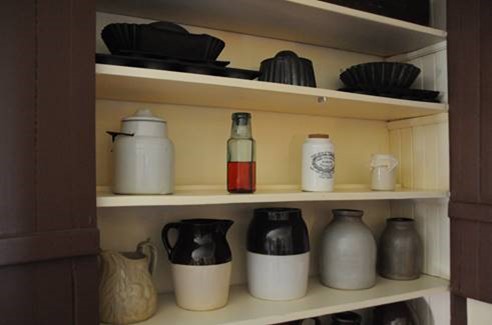
In 1985, Parks Canada restored the exterior and interior of Green Gables House to better reflect both the fictional world of Anne Shirley and the realities of a late 19th-century farm family as well as to make structural improvements and add a heating and cooling system. During this time, for safety reasons, the 18-hole golf course that had surrounded the farmhouse since 1940 was realigned slightly to remove the green and sand trap that was located directly in front of the house. There were also plans to remove the shutters and green paint on the gable walls. However, local tourism operators and the general public protested. As a result, these iconic features remain. Although not original to the house, the furnishings throughout the house are typical of the late Victorian period, and many items evoke famous scenes from Anne of Green Gables, including the dress with puffed sleeves in “Anne’s room” and the bottle of raspberry cordial in the kitchen. The “Haunted Wood” and “Lover’s Lane,” natural spaces named and frequented by Montgomery, are located in the woodlands surrounding the house and are accessible to visitors via walking trails. In 1998, the timber-framed barn, granary and woodshed were recreated to add more amenities for visitors and staff at the site.