For the week of Monday, June 26.
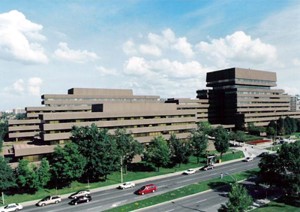
On July 2, 2013, the Government of Canada designated the Lester B. Pearson Building (125 Sussex Drive) in Ottawa, Ontario, as a Classified federal heritage building. Pearson was Secretary of State for External Affairs (1948–1957), a Nobel Peace Prize recipient (1957), and Prime Minister of Canada (1963–1968). This imposing late-modern building with Brutalist influences was named in his honour and constructed between 1970 and 1973 to house the headquarters of the Department of External Affairs (now Global Affairs Canada).
The Department of External Affairs was established in 1909. It expanded in the decades that followed, as Canada became increasingly independent from Britain and responsible for its diplomatic relations with other countries. By mid-century, its staff were working in 13 different buildings in the Ottawa area. The situation was much the same for many other federal departments. To bring their workforces together under the same roof, the Department of Public Works had launched a massive program in the postwar era to build new office towers, including many new headquarters in the National Capital Region.
The site selected for the new External Affairs headquarters was on Sussex Drive, a ceremonial route between Parliament Hill and the official residence of the Governor General of Canada at Rideau Hall. The area had undergone drastic changes over the previous decade. In 1958, the new Ottawa City Hall opened on Green Island, bringing a new modern architectural language to the area. A few years later, the National Capital Commission expropriated homes and acquired land for the construction of the Macdonald-Cartier Bridge, embassies, and new government buildings. Some of this land was set aside for the Department of External Affairs.
The architectural firm of Webb, Zerafa, Menkes, and Housden had the difficult task of coming up with a design that projected a dignified international image for the Department of External Affairs, communicated the high standard expected of Canada’s diplomats, and presented a strong impression on members of foreign embassies and visiting dignitaries. The final design consisted of four office buildings arranged around a common core area and erected on a raised podium connected to exterior terraces.
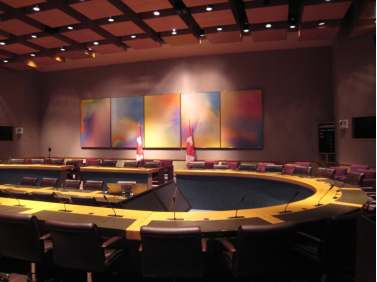
The staggered heights and asymmetrical massing are unified by cast concrete panels, recessed bands of windows, and flat roofs. The building’s ceremonial quality is expressed in spaces intended to accommodate international visitors. Entered via cast bronze entrance doors, its grand double height entrance lobby employs high quality materials such as terrazzo and polished granite. The Conference Centre, with its conference room and 200-person auditorium provide space for meetings of international delegates.
Another notable element of the design is its highly successful integration of nine artworks were created specifically for the building through the Public Works Fine Arts Programme. Today, Global Affairs Canada manages and curates fine art for display at Canada’s embassies, high commissions, consulates, and official residences, all of which contributes to Canada’s cultural diplomacy and promoting Canadian art abroad.