
Bead Island’s Living Treasure Hunt
Lake Superior National Marine Conservation Area
By: Marley MacDonald
In July 2025, the resource conservation team at Lake Superior National Marine Conservation Area (NMCA) had the joy of executing a Bioblitz event. Nestled between bigger and well-known St. Ignace Island and Simpson Island lies a small, less studied land mass by the name of Bead Island. The island itself was small but mighty; with a perimeter of just under 5km, but the surface is wild and untamed, with sheer cliff faces and deep ravines.
The purpose of the Bead Island Bioblitz was to gain as many species identifications as possible in a single day, thereby increasing knowledge of Bead Island and contributing to the ecological inventory of Lake Superior NMCA. The planning took over a month - led by students such as myself - carefully reviewing and studying various sample methods to decide which method would yield the best results. Ultimately, we decided upon taking photographs on the island, documenting, and uploading them to iNaturalist. The team itself was composed of 10 individuals, who mostly branched off into pairs or trios after beaching on the island on a four hour journey to take as many photos as possible.
It was no secret that there were many competitive members of the team who yearned to obtain the most species/most iNaturalist observations. We split up in orderly, yet hasty fashion as soon as the initial directions for the BioBlitz were finished. I took the liberty of going off on my own for a bit, eager to obtain some unique identifications. When I looked up upon the largest hill on the island, I knew I had to climb it. I was met with a breathtaking view, and countless plant, insect, and fungi species to photograph and identify.
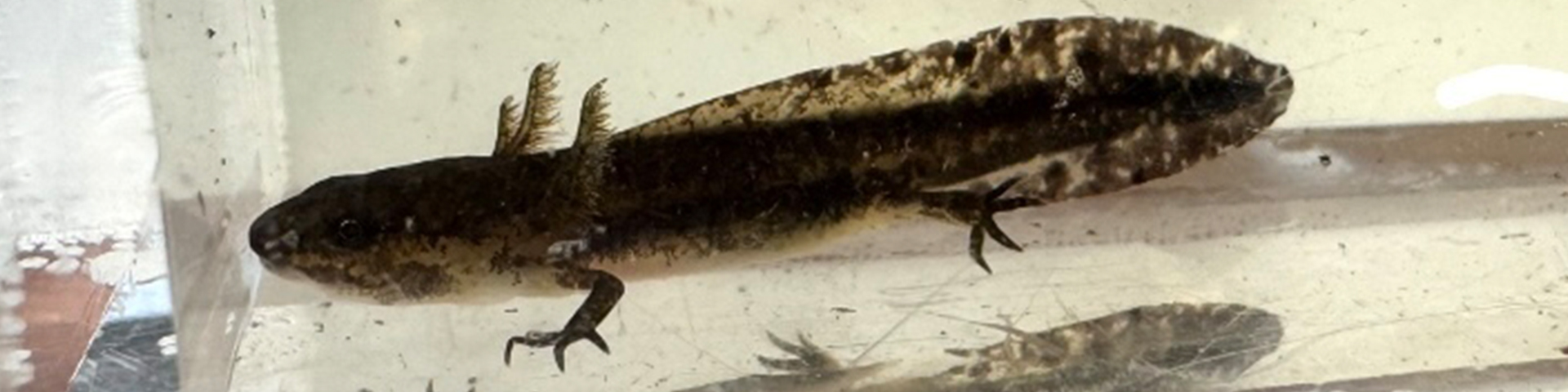
Beyond the hill laid the opposite rocky shoreline, which provided what I believe to be the most interesting identification of the day: salamander larvae. These small larvae (probable Blue-spotted Salamanders) were swimming within the small pools, tucked in closely with the tadpoles (probable Boreal Chorus Frogs). Beside these pools laid a carpet of Butterwort and Round-leaved Sundew plants, which are native carnivorous plants of the Lake Superior shores. The shoreline proved fruitful with other species, such as Eastern Garter Snakes, a Bald Eagle, and even a Marbled Purple Jumping Spider!
Overall, the team amassed 700 observations, with 273 different species! The most observed species within the bioblitz was the Round-Leaved Sundew, with Shrubby Cinquefoil as a runner up! The winner of the Biggest Nerd award, with the highest individual total of 149 observations, was Joe-Felix Bienentreu. I like to think I won in spirit after scaling the highest point on the island, and I definitely won for the nicest view of the day!
So how many species can YOU identify in one day? As a student at Parks Canada, I found that every day can be a BioBlitz: whether I’m in the office or out doing fieldwork, there’s nothing quite like stopping to smell the flowers, or in my case, take pictures of them!
- Date modified :