
What a CREEL-y Fantastic Summer of Surveys!
Lake Superior National Marine Conservation Area
By Rachel McTavish
The word creel might sound old-fashioned, but it has deep roots in fishing tradition. It refers to the woven basket anglers once used to carry their catch. That history lives on today in the term creel survey, a method used to learn more about recreational fishing activity. This summer, Resource Conservation students took to the water and surveyed hundreds of anglers to find out just how much time and effort people devote to catching and harvesting fish recreationally across the region.
Collecting data on fishing effort, angler perceptions and catch rates on Lake Superior is essential to the livelihoods and culture of North Shore communities. This information supports Parks Canada and the Ministry of Natural Resources (MNR) in monitoring fish populations, recreational fishing trends and visitor experiences in Lake Superior National Marine Conservation Area (LSNMCA).
The MNR and LSNMCA teamed up this summer to capture a complete picture of recreational fishing efforts on the North Shore, with creel surveys in Thunder Bay, Black Bay, and Nipigon Bay. From May to August, Parks Canada students creeled at Red Rock Marina, Nipigon Marina, Rossport Dock, and Terrace Bay Dock. Survey days, times, and locations were randomized to avoid bias in data collection. Anglers were asked about their place of residence, how long they spent fishing from shore or boat, where they fished within the NMCA, which species they targeted, how many fish they caught, released, or kept, their level of satisfaction with the experience, and whether they felt fishing quality had changed compared to last year. In addition, we asked anglers’ opinions on the management of the fishery.
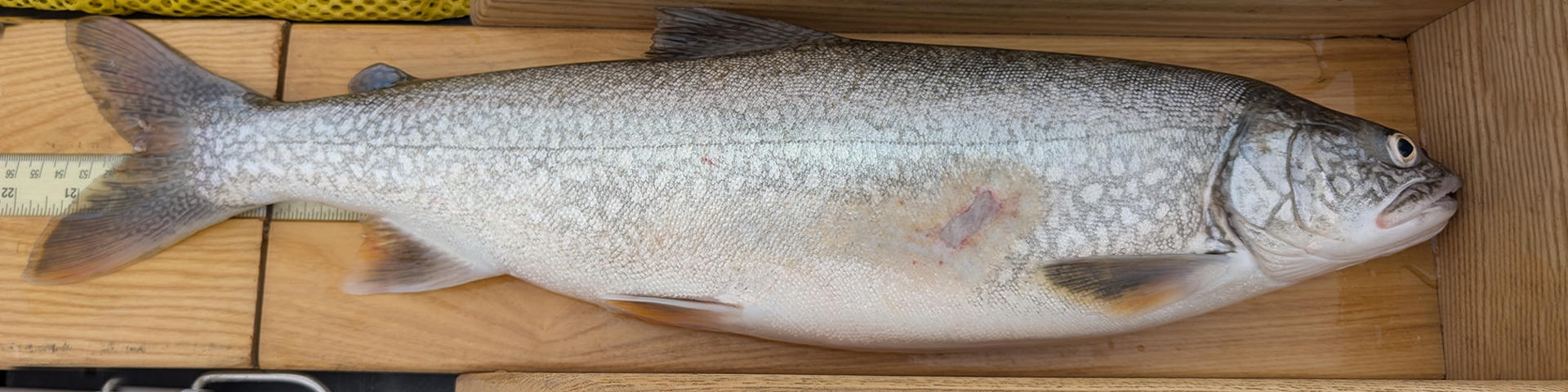
Whenever anglers kept fish, we measured the fork length, full length and weight. Sea Lamprey scars or Sea Lice on the fish were also recorded on the data sheets.
In May, the team learned about the large amounts of Yellow Perch being caught and measured: one turned out to be 33.02 cm (12 in) long! A highlight was attending the Red Rock Annual Trout Derby on June 7th, where measurements of 30 different fish were recorded. The largest Lake Trout that weekend measured a whopping 86.36 cm (34 in) long and 10.88 kg (23.95 lbs)!
Preliminary results show that Lake Trout were the most frequently caught species, many bearing Sea Lamprey scars. Most anglers were local, but we also met people from southern and western Ontario, and even Minnesota. Regular Lake Superior anglers reported catching fewer fish over the years, but most were still highly satisfied with their experience, even if they got skunked. Gichigami’s beauty makes every trip worthwhile.
Creel surveys provide an opportunity to collect data, find answers, and impact decision making. The data collected in 2025 will be used in monitoring recreational fishing efforts by MNR and help shape visitor experience at LSNMCA.
Next time you come across someone wanting to ask you questions at the dock, just know there’s no big deal with getting Creel’d! Your answers will help better the lake you love!
Learn more about research and monitoring projects at the LSMNCA. (https://parks.canada.ca/amnc-nmca/on/super/nature/conservation/recherche-research)
- Date modified :