
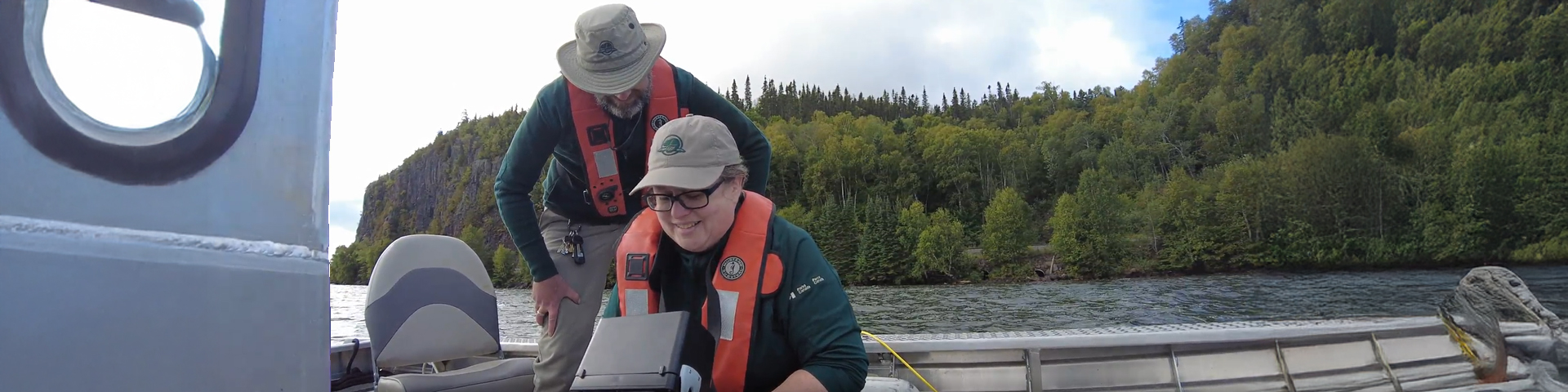
Sharing Our Stories of Maritime History
Lake Superior National Marine Conservation Area
By Lisa Sonnenburg and Liam Giffin
In June of 2024, Lisa Sonnenburg and Liam Giffin from Lake Superior National Marine Conservation Area (NMCA) travelled to St. Catherines, Ontario, to present about Parks Canada underwater research at the joint Canadian Nautical Research Society and North American Society for Oceanic History Conference hosted by Brock University.
For those of you who have followed the adventures of our Remote Operated Vehicles (ROVs), you know that Lake Superior NMCA has exciting cultural history that lies just beneath the surface of Lake Superior. Since our initial discovery of a mystery train wreck in 2022 , we have documented the remnants of another train wreck, as well as the remains of submerged railway infrastructure in Rossport. We wanted to highlight these finds and share our use of the latest technology combined with knowledge from local residents. We headed to St. Catherines looking forward to sharing our knowledge and meeting maritime history experts from across North America.
As our presentation was the final session on the last day, w. We spent the first two days listening to a variety of interesting speakers. Topics included everything from ship design to military strategy, to the roles of race and gender in waterfront labour, and so much more. We also had the opportunity to connect with independent scholars, university professors, and civil servants, who shared our love for all things maritime.
Happily, our presentation was a hit! Instead of a traditional PowerPoint, we opted for a timed video with narration. It allowed the audience to see footage captured by our ROVs , as well as photographic comparisons of the modern and historic landscape. The communities along the shores of Lake Superior NMCA have strong and enduring ties to the railroad and the lake itself. While it may seem odd to deliver a railway presentation at a maritime conference, we were able to describe how stories about the railroad were passed within communities and families, allowing Parks Canada to use regional oral histories to locate underwater archaeological proof. Through the lens of underwater archaeology, we illustrated the unique interaction between the early railway and Lake Superior and the challenges faced by those building and operating these crucial railways connecting West to East.
In the near future, we are creating a video based on this presentation to post on Parks Canada’s YouTube channel . We look forward to sharing our ongoing work of documenting, protecting, and promoting Canada’s cultural heritage.
- Date modified :