
Island plants are cool!
Lake Superior National Marine Conservation Area
By Douglas Tate and Kimberly Teager
Among the many interesting and cool things found along the north shore of Lake Superior are the thriving coastal plant communities. From towering evergreen trees to delicate mosses, the biodiversity is astounding.
If you have ever gone swimming in the big lake, you can probably attest to the fact that the water stays relatively cold throughout summer, and with that much cold water around, the lake’s shoreline tends to stay much cooler than inland areas. Where water meets land, it is also often rocky, windswept, and exposed to waves and spray. This difference in conditions within a short distance (known as microclimate) affects how well plants can grow and what species can survive in this habitat.
Over the years, biologists have noticed that some of the plant species on Lake Superior’s rocky coasts and islands are uncommon or absent in the boreal forest, but are found much farther north, or at higher altitudes in mountainous regions. A report from 1981, called “The Arctic-Alpine Element of Vascular Flora at Lake Superior,” identified 48 species with this kind of gap in their distribution, often referred to as disjunct populations. It is thought that these plants grew here when the region was at the edge of the glaciers some 10,000 years ago; as the ice melted and the glaciers receded, the conditions changed inland allowing the boreal forest to grow. At the edge of the lake however, conditions remained cool, moist and windy, and these “arctic” plant communities persisted.
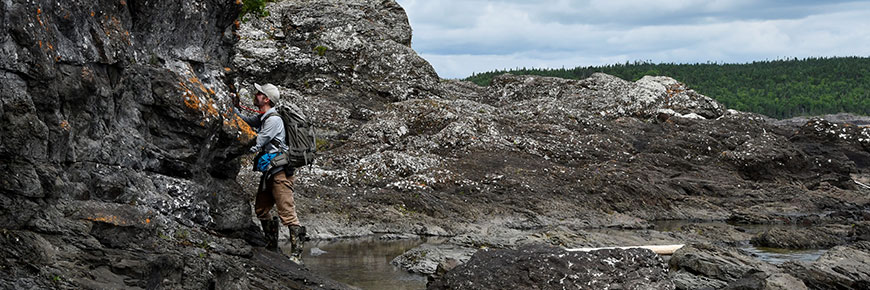
As part of the goal to improve knowledge of species and habitats, Lake Superior National Marine Conservation Area staff planned a series of ecological inventory trips in the summers of 2018 and 2019.
To get a better understanding of plant communities on the islands, and particularly those in exposed shoreline habitats, Parks Canada staff were joined by Sam Brinker, a botanist with the Natural Heritage Information Centre. Each inventory trip focussed on a different section in the 10,000+ square kilometre marine conservation area, like the islands near Rossport, or the Loon Harbour archipelago. Using Parks Canada’s vessel, “Coaster,” we visited some previously known rare plant sites, and explored some new areas. In addition to vascular plants, the team also recorded numerous lichen species, which are often the first sign of life at the edge of retreating glaciers.
These trips were a big success, increasing the list of known plant and animal species, as well as familiarizing staff with the islands, channels, safe harbours, geological and cultural features – all of which help to improve operational capacity, and inform the development of a long-term plan for monitoring the ecological sustainability of the site. For a taste of what plant species were found, tune in to the next edition of shoreLINES!
Back to shoreLINES
- Date modified :