
Quarterly financial report for the quarter ended June 30, 2025
In the event of a conflict, the PDF version precedes over all other information
Introduction
This quarterly report has been prepared by management as required by section 65.1 of the Financial Administration Act and in the form and manner prescribed by the Treasury Board. This report should be read in conjunction with the Main Estimates, the Supplementary Estimates and the previous Quarterly Financial Reports.
A summary description of the Parks Canada’s programs can be found in Part II of the Main Estimates, and a detailed description in Part III – Departmental Plans.
This quarterly report has not been subject to an external audit. However, it has been reviewed by Parks Canada's independent external Audit Committee.
Basis of presentation
This quarterly report has been prepared using an expenditure basis of accounting. The accompanying Statement of Authorities includes the Parks Canada’s spending authorities granted by Parliament, and those used by the Agency consistent with the Main Estimates for the 2025-26 fiscal year. This quarterly report has been prepared using a special purpose financial reporting framework designed to meet financial information needs with respect to the use of spending authorities.
The authority of Parliament is required before money can be spent by the Government. Approvals are given in the form of annually approved limits through appropriation acts or through legislation in the form of statutory spending authority for specific purposes.
Parks Canada uses the full accrual method of accounting to prepare and present its annual departmental financial statements that are part of the departmental results reporting process. However, the spending authorities voted by Parliament remain on an expenditure basis.
Highlights of fiscal quarter and fiscal year-to-date results
This section highlights the financial results for the quarter and fiscal year-to-date ended June 30, 2025, and provides explanations of variances compared with the same period last year.
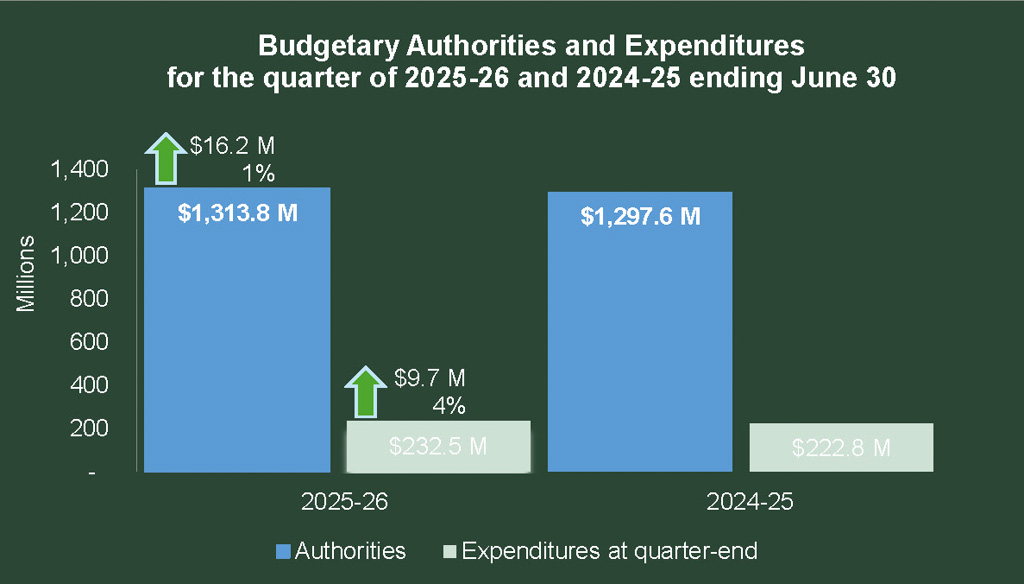
Budgetary Authorities and Expenditures for the quarter of 2025-26 and 2024-25 ending June 30 — Text version
| Authorities and expenditures | 2025 to 2026 | Change | 2024 to 2025 |
|---|---|---|---|
| Authorities | $1,313.8 | $16.2 1% |
$1,297.6 |
| Expenditures at quarter-end | $232.5 | $9.7 4% |
$222.8 |
Statement of authorities (Table 1)
Authorities available for use
This quarterly report reflects the funding available for use from the 2025-26 Main Estimates and the 2024-25 unused revenue re-spending authority. Consistent with the current year, the authorities at the same time last year consisted of 2024-25 Main Estimates and the 2023-24 unused revenue re-spending authority.
At June 30, 2025, Parks Canada’s total authorities available for use for the year ending March 31, 2026, are $16.2 million (or 1%) higher when compared to the same quarter of the previous year (from $1,297.6 million to $1,313.8 million). The variance is primarily due to:
- An increase in authorities due to the following factors:
- $95.1 million related to the funding for the Preliminary Recovery and Rebuild of Jasper National Park;
- $25.0 million related to a permanent adjustment to the revenue authorities;
- $10.0 million related to the Federal Contaminated Sites Action Plan;
- $6.9 million related to funding to settle land related claims and litigation;
- $5.1 million related to the Pituamkek National Park Reserve.
- The increase in authorities is offset by the following decreases:
- $50.3 million related to temporary funding for Real Property & Asset;
- $22.5 million in the carryforward revenue funds from 2024-25 that is included in the 2025-26 authorities compared to the previous year;
- $39.8 million related to Enhanced Nature Legacy;
- $14.9 million for other net decreases related to temporary funding:
- $9.6 million related to Federal Framework to Address the Legacy of Residential Schools;
- $5.3 million related to Wood Buffalo National Park Action Plan & Wood Bison.
Authorities used during the quarter
In the first quarter of 2025-26, total net budgetary expenditures were $232.5 million compared to $222.8 million reported for the same period in 2024-25, resulting in an increase of $9.7 million (or 4%).
Table 1 provides information on the authorities available for use and used during this quarter.
Budgetary expenditures by Standard Object (Table 2)
Planned by standard object
Total planned expenditures, for the year ending March 31, 2026, are $16.2 million (or 1%) higher compared to the previous year.
The increases are mainly observed in planned spending in the following areas:
- Professional and special services, largely due to the funding for Real Property & Asset program, Preliminary Recovery and Rebuild of Jasper National Park and Federal Contaminated Sites Action Plan;
- Repair and maintenance, largely due to the funding for Real Property & Asset program.
These increases are partially offset by decreases in planned spending in the following areas:
- Acquisition of land, building and works, largely due to the funding for Real Property & Asset program;
- Transfer payments, largely due to the reduction for the National Urban Parks program.
Expended by standard object
As per Table 2 (Budgetary expenditures by Standard Object), the $9.7 million increase compared to the same quarter of the previous year is mainly due to the following increase:
- $13 million in Transfer payments mainly due to the timing of contribution payments, which were made in subsequent quarter of 2024-25.
Offset by the following decrease:
- $2.5 million in Information, mainly due to a reduction in advertising campaigns.
New Parks and Historic Sites (Table 3)
The total available at the beginning of 2025–26 is $216.0 million, compared to $211.2 million at the beginning of 2024–25. The $4.8 million increase is explained by $35.6 million in receipts of parliamentary authorities and $30.8 million in expenditures incurred in 2024–25. The highest spending was observed for the Tallurutiup Imanga National Marine Conservation Area, where $14.8 million was spent.
During the first quarter, $5 million was expensed from the New Parks and Historic Sites accounts, which is comparable to the same period in 2024–25.
Table 3 provides information on the New Parks and Historic Sites account available for use and used during this quarter.
Risks and uncertainties
Climate change
In response to the risk of climate change, which presents significant threats to the ecosystems, cultural heritage, infrastructure, and services it manages and delivers, Parks Canada assesses climate change risk to individual places, seeks to understand its potential impacts and identifies measures for feasible and effective adaptation and response. Parks Canada also aims to integrate a climate lens into national policies, strategies, and planning processes through the creation of function-specific guidance, tools, and other resources that consider current and future climate conditions across all areas of responsibility. It will also work to review emergency management procedures, particularly to prepare for and respond to the challenges of wildfires, flooding, erosion, and other climate change-related natural disasters.
Legal and regulatory environment for Indigenous rights
The legal and regulatory environment for Indigenous rights in Canada that Parks Canada operates under, challenges its ability to deliver on its priorities, namely to honour and support Indigenous stewardship as outlined in the new Indigenous Stewardship Policy, and to fulfil its obligations under the United Nations Declaration on the Rights of Indigenous Peoples Act (UNDA) Action Plan. Falling short of obligations will have a negative impact on Parks Canada’s relationships with Indigenous peoples, communities, and organizations as well as the management of the places it administers.
Parks Canada will also work to strengthen relationships with Indigenous partners where they exist and work to build relationships where they do not, working to facilitate Indigenous relationships with their traditional lands, waters, and ice. Parks Canada will also advance the realization of its commitments in the UNDA Action Plan through avenues like the newly released Indigenous Stewardship Policy and the Indigenous Stewardship Circle, including by developing, in consultation with Indigenous peoples, a measurement framework to measure UNDA Action Plan progress. Internally, Parks Canada will also investigate, with Indigenous partners, methods, and approaches to weave different knowledge systems to inform conservation planning and decision-making.
Digital modernization
If Parks Canada does not meet the pace or requirements of digital modernization, its ability to deliver critical and non-critical services to Canadians due to aging information technology and information management processes will be increasingly at risk. Mitigations include completing upgrades to critical applications that support essential safety functions, reviewing current digital tools through its application portfolio management approaches, retiring those that have low business value, and focusing on improving the technological health of priority digital tools. Parks Canada will also implement a new Investment and Project Management system and an Enterprise Data Management solution which will provide a centralized platform for planning, tracking, results, and overseeing projects and investments.
Asset sustainability
Asset sustainability continues to be a significant area of risk for Parks Canada as time-limited funding comes to an end; as a result, its ability to maintain the condition of its significant asset portfolio is challenged.
To mitigate these risks, Parks Canada will continue work to articulate future funding requirements to increase and supplement its base capital allocation for its fixed asset portfolio. Given the impending sunset of approved, temporary asset funding, there is a sizeable gap between existing funding levels and requirements for annual, long-term capital and maintenance investment to sustain Parks Canada’s asset dependent programs. Existing projects to invest time-limited funding to support priority improvements to its heritage and contemporary built asset portfolio will be completed, with new investments focusing on the most urgent projects, such as assets in conditions posing the greatest risk to the health and safety of visitors, users, local residents, and Parks Canada team members. Parks Canada will also prioritize new investments to strengthen regulatory compliance and address health and safety issues in its built heritage assets portfolio and continue to conduct impact analyses identifying potential threats and proposing approaches to ensure the protection of its built heritage assets.
Further, as part of Parks Canada’s transition to a modernized Departmental Results Framework, program-critical asset segments will be treated within the Program Inventory and managed as a part of Parks Canada’s programs. Program reviews and the program integrity’s dependence upon asset condition, availability, and utility will qualify and quantify this risk under a different model.
Financial sustainability
To address the risk of financial sustainability, Parks Canada will advance initiatives to modernize and integrate its financial, investment, and project management regimes to support the implementation of strengthened planning, forecasting, and budgeting practices to ensure effective financial resource management. It will also design and implement strengthened, renewed and more efficient governance processes, systems, and tools to improve oversight and efficacy. Parks Canada will also implement the findings of the enterprise-wide review that assessed resource levels across all business units by identifying baseline resource requirements for the sustainable delivery of mandated activities. This will be coordinated with the transition to a modernized Departmental Results Framework and implementation of an effective integrated financial and business planning. It will also work to advance the optimization of its real property portfolio by focusing on affordability and core assets required for the delivery of the Parks Canada mandate. Together these processes and frameworks support priority-setting, resource allocation against priorities and enable regular program review and assessment.
Significant changes in relation to operations, personnel and programs
There have been no significant changes in relation to operations, personnel and programs to report during this quarter.
Approval by senior officials
Approved by:
Ron Hallman
President & Chief Executive Officer,
Parks Canada
Gatineau, Canada
Date: August 18, 2025
Claudie Besner, CPA
A/Vice-President Finance & Chief Financial Officer,
Parks Canada
Gatineau, Canada
Date: August 14, 2025
| (in thousands of dollars) | Total available for use for the year ending March 31, 2026 Footnote1 | Used during the quarter ended June 30, 2025 | Year-to-date used at quarter-end | Total available for use for the year ending March 31, 2025 Footnote1 | Used during the quarter ended June 30, 2024 | Year-to-date used at quarter-end |
|---|---|---|---|---|---|---|
| Vote 1 – Operating expenditures, grants and contributions | 734,833 | 142,588 | 142,588 | 657,875 | 136,246 | 136,246 |
| Vote 5 – Capital expenditures | 242,548 | 21,351 | 21,351 | 307,213 | 22,616 | 22,616 |
| Vote 10 – Payments to the New Parks and Historic Sites account | 30,637 | - | - | 35,650 | - | - |
| Statutory – Contributions to employee benefit plans | 69,878 | 17,469 | 17,469 | 63,469 | 15,867 | 15,867 |
| Statutory – Expenditures equivalent to revenues resulting from the conduct of operations pursuant to section 20 of the Parks Canada Agency Act | 235,912 | 51,073 | 51,073 | 233,398 | 48,110 | 48,110 |
| Total budgetary authorities | 1,313,808 | 232,481 | 232,481 | 1,297,605 | 222,839 | 222,839 |
| (in thousands of dollars) | Planned expenditures for the year ending March 31, 2026 Footnote2 | Expended during the quarter ended June 30, 2025 | Year-to-date used at quarter-end | Planned expenditures for the year ending March 31, 2025 Footnote2 | Expended during the quarter ended June 30, 2024 | Year-to-date used at quarter-end |
|---|---|---|---|---|---|---|
| Personnel | 536,237 | 151,549 | 151,549 | 523,386 | 149,069 | 149,069 |
| Transportation and communications | 18,405 | 3,123 | 3,123 | 16,054 | 3,398 | 3,398 |
| Information | 9,247 | 513 | 513 | 14,765 | 2,986 | 2,986 |
| Professional and special services | 187,972 | 17,005 | 17,005 | 149,244 | 16,626 | 16,626 |
| Rentals | 28,707 | 3,815 | 3,815 | 31,622 | 5,369 | 5,369 |
| Repair and maintenance | 62,884 | 3,316 | 3,316 | 28,171 | 2,386 | 2,386 |
| Utilities, materials and supplies | 83,815 | 8,882 | 8,882 | 91,155 | 10,476 | 10,476 |
| Acquisition of land, buildings and works | 215,154 | 15,988 | 15,988 | 253,911 | 16,907 | 16,907 |
| Acquisition of machinery and equipment | 37,500 | 3,372 | 3,372 | 39,957 | 3,706 | 3,706 |
| Transfer payments | 76,220 | 24,068 | 24,068 | 89,498 | 11,075 | 11,075 |
| Public debt charges | - | - | - | - | 9 | 9 |
| Other subsidies and payments | 57,667 | 850 | 850 | 59,842 | 832 | 832 |
| Total budgetary authorities | 1,313,808 | 232,481 | 232,481 | 1,297,605 | 222,839 | 222,839 |
| (in thousands of dollars) | New Parks and Historic Sites account during the quarter ended June 30, 2025 | New Parks and Historic Sites account for the year ending March 31, 2026 | New Parks and Historic Sites account during the quarter ended June 30, 2024 | New Parks and Historic Sites account for the year ending March 31, 2025 |
|---|---|---|---|---|
| Available at beginning of year | 216,084 | 211,253 | ||
| Receipts: | ||||
| Donations | 1 | 1 | - | - |
| Expenditures | 5,037 | 5,037 | 5,991 | 5,991 |
| Available at the end of the quarter | 211,048 | 205,262 |
Related links
- Quarterly financial report for the quarter ended December...
- Quarterly financial report for the quarter ended September...
- Quarterly financial report for the quarter ended December...
- Quarterly financial report for the quarter ended September...
- Quarterly financial report for the quarter ended June 30,...
- Quarterly financial report for the quarter ended June 30,...
- Quarterly financial report for the quarter ended September...
- Quarterly financial report for the quarter ended December...
- Date modified :