What We Heard (Executive Summary):
Lake Louise Area Visitor Use Management — Phase 2: Draft Strategies and Actions
Banff National Park
- What We Heard (Executive Summary): Lake Louise Area Visitor Use Management Report — Phase 2: Draft Strategies and Actions (PDF, 2.1 Mb)
A full version of this report is also available
View the full report here.
Cette publication est aussi disponible en français.
Overview of the Engagement
Rising visitation to Banff National Park has created congestion issues in the Lake Louise area affecting access, ecological integrity, overall enjoyment, and requiring active management to address public safety risks. With visitor and vehicle volumes expected to grow, Parks Canada is creating a visitor use management plan for the Lake Louise area.
This work is guided by the internationally recognized Visitor Use Management (VUM) framework, as well as the 2022 Banff National Park Management Plan. In managing national parks, Parks Canada is mandated to restore ecological integrity while providing all Canadians with opportunities to discover and enjoy these special places.
From February 3 to March 9, 2026, Parks Canada asked for feedback on a set of proposed visitor use management strategies and actions to help achieve desired conditions. Feedback was solicited through three public surveys at LetsTalkMountainParks.ca:
- Survey 1 - proposed general strategies and actions applicable to the entire Lake Louise project area.
- Survey 2 - proposed strategies and actions applicable to Upper Lake Louise (the lakeshore).
- Survey 3- proposed strategies and actions applicable to Moraine Lake and Paradise Valley.
The surveys included a combination of 5-point Likert scales (1-5), open-ended questions and one ranking question. Each survey was intended to take 15 minutes or less to complete. Questions were designed to assess the proposed strategies and actions for:
- the perceived effectiveness to achieve the desired conditions;
- level of support;
- concerns, comments and suggested alternatives.
Who we heard from
A total of 1,697 responses were received across all three surveys (survey 1 = 755, survey 2 = 538, survey 3 = 404). Participants may have completed one, two or all the surveys. Five email responses were also submitted and coded along with the surveys.
Nearly three quarters of respondents were either residents of the Bow Valley including Lake Louise, Banff, Canmore, and Exshaw (26-32%), or lived in or around Calgary including Airdrie, Cochrane, and Okotoks (40-44%). The remainder of the respondents lived elsewhere in Alberta (12-14%), Canada (12-14%) or internationally (2-3%).
While the vast majority of survey respondents were Alberta residents, this is not representative of recent visitation demographics to Banff National Park or the Lake Louise area. It is worth noting that regional and local respondents’ views are overrepresented in the unweighted data and may not represent the views of all visitors.
Respondents from the Bow Valley, Calgary, elsewhere in Alberta and parts of BC often saw themselves as ‘local’ to the Lake Louise area regardless of their place of residence.
Many respondents, had visited the Lake Louise area (64%) or Upper Lake Louise (65%) within the past year. Respondents from the Bow Valley were more likely to have visited recently with 85% indicating they had visited within the past year. Most respondents who visited these two locations reported using a personal or rental vehicle (81-85%). Visitation data from 2025 indicated that approximately 3,100 visitors daily arrive to Upper Lake Louise in personal or rental vehicles and 2,300 on shuttles.
Moraine Lake had fewer visits in the last year but 70% of respondents still visited less than three years ago. Survey respondents who visited Moraine Lake recently were more likely to have used Parks Canada shuttles. Today, more than 97% of visitors to Moraine Lake arrive by public or private mass transit due to personal vehicles restrictions on Moraine Lake Road introduced in 2023. For Paradise Valley, 40% of respondents had never visited.
Both survey respondents and park visitors prefer to travel in personal vehicles when possible and, respondents therefore, may have prioritized solutions that support this mode of travel.
Back to topSummary of Findings:
The strategies and actions presented were largely perceived as being effective. Respondents broadly support Parks Canada in taking the necessary actions to address the challenges in the area; however, they want to understand the reasoning behind these decisions. Support for protecting nature and wildlife was reiterated through these surveys and is consistent with earlier public engagement for this project (desired conditions) and the Banff National Park Management Plan.
- Visitation Volume: Many respondents supported reducing the number of visitors at key locations (e.g. visitor capacity) to help with crowding and congestion. Others felt congestion could be addressed by expanding parking lots, increasing services or growing infrastructure to accommodate ongoing increases in visitation.
- Access Considerations: Respondents care deeply about Lake Louise and have fond memories of the area. Many visit frequently, care about ecological integrity and want to continue to build memories long into the future. While they agree that visitor use is causing challenges and support actions to reduce congestion, they want the area to be easy to access.
- Preferential Access: Many respondents requested preferential access for locals. The definition of those who considered themselves ‘local’ varied by respondent but often included Bow Valley residents, Albertans and occasionally all Canadians. Forms of preferential access proposed included reservation blocks or dedicated parking for ‘locals’, or tiered pricing for non-local visitors.
- Price Strategies: While affordability remains a concern, respondents are supportive of using price strategies to manage visitation. Some felt that increasing entry fees would help manage visitation, especially during peak summer months, and that fees would be positively received if they supported the improvement of the site.
- Reservation Systems: There is general understanding about the benefits of reservations to provide predictable and certain access. Respondents would like tickets to be easier to obtain and require less advanced planning. Some feel that creating capacities or requiring reservations in more locations will make the reservation process more challenging and stressful. They also wanted assurances that Parks Canada could prevent bots, mass ticket purchase or ticket reselling. Many suggested changes such as random draws and rolling booking windows to help ensure equity.
Some of the suggestions received require a nationwide approach or are incompatible with the 2022 Banff National Park Management Plan or the Canada National Parks Act. These include expanding the developed footprint, increasing entry fees, preferential access, and surge or tiered pricing. These suggestions will be taken under advisement by Parks Canada but are outside the scope of the current Lake Louise Area VUM planning process.
Survey #1: General Strategies
This survey explored four general strategies and their associated actions for the entire project area. The strategies were largely perceived as being effective, with strategy one (manage congestion and access) having the lowest perceived effectiveness at 56% and strategy three (protect wildlife and ecosystems) the highest at 71%.
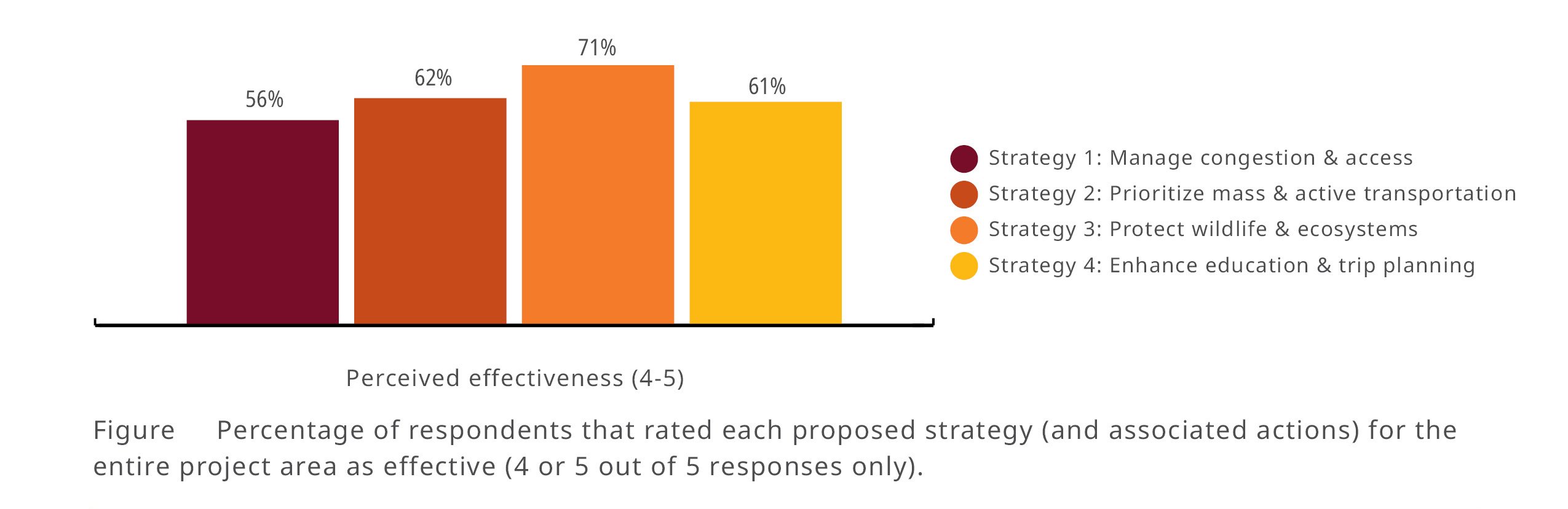
Figure 1: Percentage of respondents that rated each proposed strategy (and associated actions) for the entire project area as effective (4 or 5 out of 5 responses only).
- Strategy 1: Manage Congestion and Access 56%
- Strategy 2: Prioritize Mass and Active Transportation 62%
- Strategy 3: Protect Wildlife and Ecosystems 71%
- Strategy 4: Enhance education and Trip Planning 61%
Survey #2: Upper Lake Louise
This survey explored the perceived effectiveness of level of support for, and willingness to use four potential scenarios to manage congestion at Upper Lake Louise:
- Scenario A: First-come, first- served paid parking
- Scenario B: Parking reservations with no entry restrictions
- Scenario C: Parking reservations with timed-entry and fixed length of stay
- Scenario D: Personal vehicles restricted. Access by shuttle, transit or active modes.
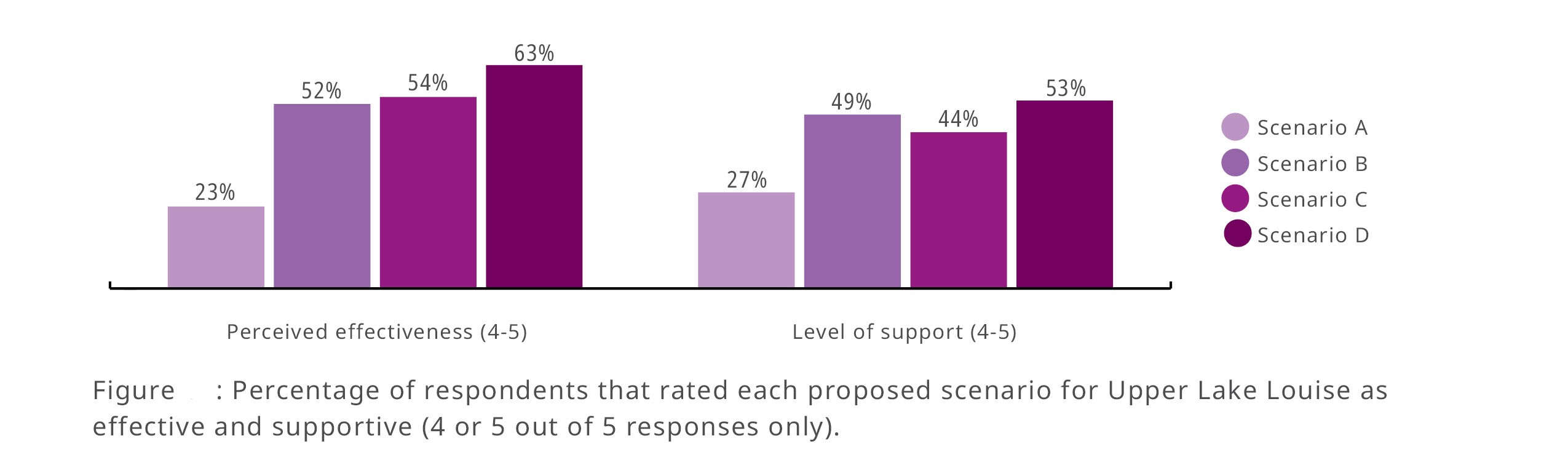
Figure 2: Percentage of respondents that rated each proposed scenario for Upper Lake Louise as effective and supportive (4 or 5 out of 5 responses only).
Perceived effectiveness (4-5)
- Scenario A: First-come, first-served paid parking 23%
- Scenario B: Parking reservations with no entry restrictions 52%
- Scenario C: Parking reservations with timed-entry and fixed length of stay 54%
- Scenario D: Personal vehicles restricted. Access by shuttle, transit or active modes. 63%
Level of support (4-5)
- Scenario A: First-come, first-served paid parking 27%
- Scenario B: Parking reservations with no entry restrictions 49%
- Scenario C: Parking reservations with timed-entry and fixed length of stay 44%
- Scenario D: Personal vehicles restricted. Access by shuttle, transit or active modes. 53%
Scenario B received the strongest overall support. While Scenario D attracted the most first choice support, it was equally as often rated as the least preferred option.
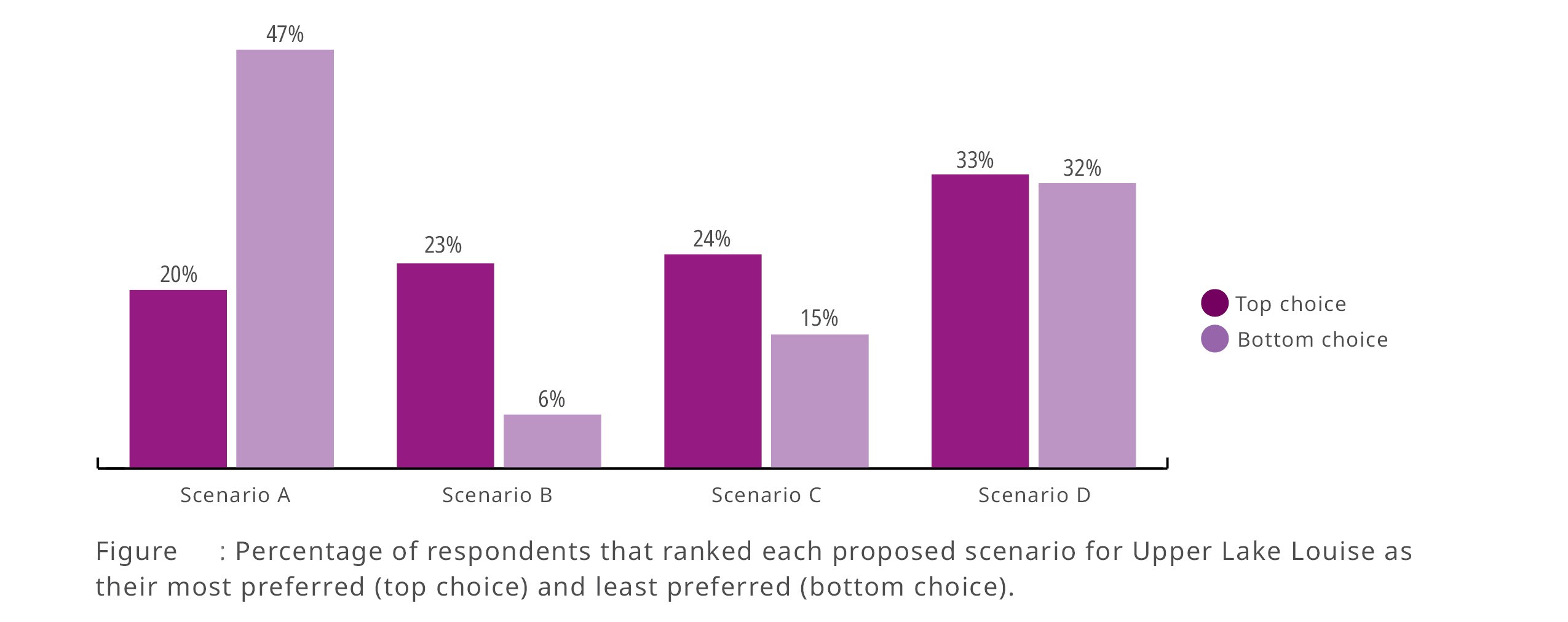
Figure 3: Percentage of respondents that ranked each proposed scenario for Upper Lake Louise as their most preferred (top choice) and least preferred (bottom choice).
Top choice
- Scenario A: First-come, first-served paid parking 20%
- Scenario B: Parking reservations with no entry restrictions 23%
- Scenario C: Parking reservations with timed-entry and fixed length of stay 24%
- Scenario D: Personal vehicles restricted. Access by shuttle, transit or active modes. 33%
Bottom choice
- Scenario A: First-come, first-served paid parking 47%
- Scenario B: Parking reservations with no entry restrictions 6%
- Scenario C: Parking reservations with timed-entry and fixed length of stay 15%
- Scenario D: Personal vehicles restricted. Access by shuttle, transit or active modes. 32%
Scenario A – This scenario was often seen as undesirable as it is closest to current conditions. It was the least preferred scenario for nearly half of respondents (47%). Respondents from the Calgary area rejected this option least often (27%).
Scenarios B and C – Both scenarios were seen as reasonable options, with B performing slightly better. Respondents felt that key details, such as length of stay, visitor compliance and enforcement, would need to be clearly defined before implementation. Scenarios B and C were not only ranked as high-top choices but were least likely to be ranked last. Many acknowledged that these options would be the hardest to implement.
Scenario D – While seen as the most effective option, Scenario D was also the most polarizing, as it restricts arrival by personal vehicle. It was the most preferred option for 33% of respondents and the least preferred option by 32%. Bow Valley residents (46%) and Canadians from outside Alberta (39%) were the most likely to select Scenario D as their first choice. In contrast, 41% of Calgary respondents ranked it as their last choice, compared to only 23% of Bow Valley respondents.
Survey #3: Moraine Lake and Paradise Valley
The purpose of this survey was to measure the perceived effectiveness or level of support for potential actions at Moraine Lake and at Paradise Valley.
Moraine Lake
Respondents were asked whether the strategies and actions presented would improve the visitor experience and help better protect the environment. Of the respondents (n=404), over half (53%) felt that the actions would improve the visitor experience while slightly less than half (42%) thought they would help protect wildlife.
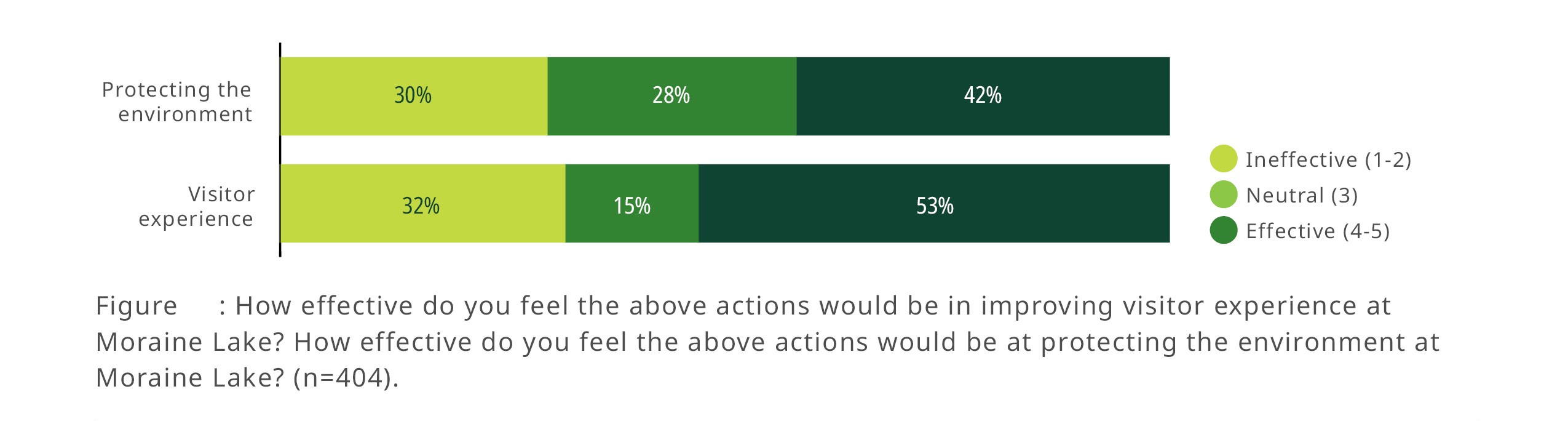
Figure 4: How effective do you feel the above actions would be in improving visitor experience at Moraine Lake? How effective do you feel the above actions would be at protecting the environment at Moraine Lake? (n=404).
Protecting the environment
- Ineffective (1-2) 30%
- Neither (3) 52 28%
- Effective (4-5) 42%
Visitor experience
- Ineffective (1-2) 32%
- Neither (3) 15%
- Effective (4-5) 53%
When asked what concerns they had about capacity allocation, respondents (n=304) often supported setting visitation limits because they feel the area is overcrowded (34%). However, they nearly always paired this support with concerns about allocation including:
- requests for preferential access for locals
- commercial operator volumes
- affordability
- access for key user groups, including mountaineers and hikers
- reservation system improvements
Paradise Valley
Nearly one quarter (24%) of respondents (n=306) who took part in the third survey chose to skip questions pertaining to Paradise Valley. However, 92% of Bow Valley respondents who took part in this third survey decided to complete this section.
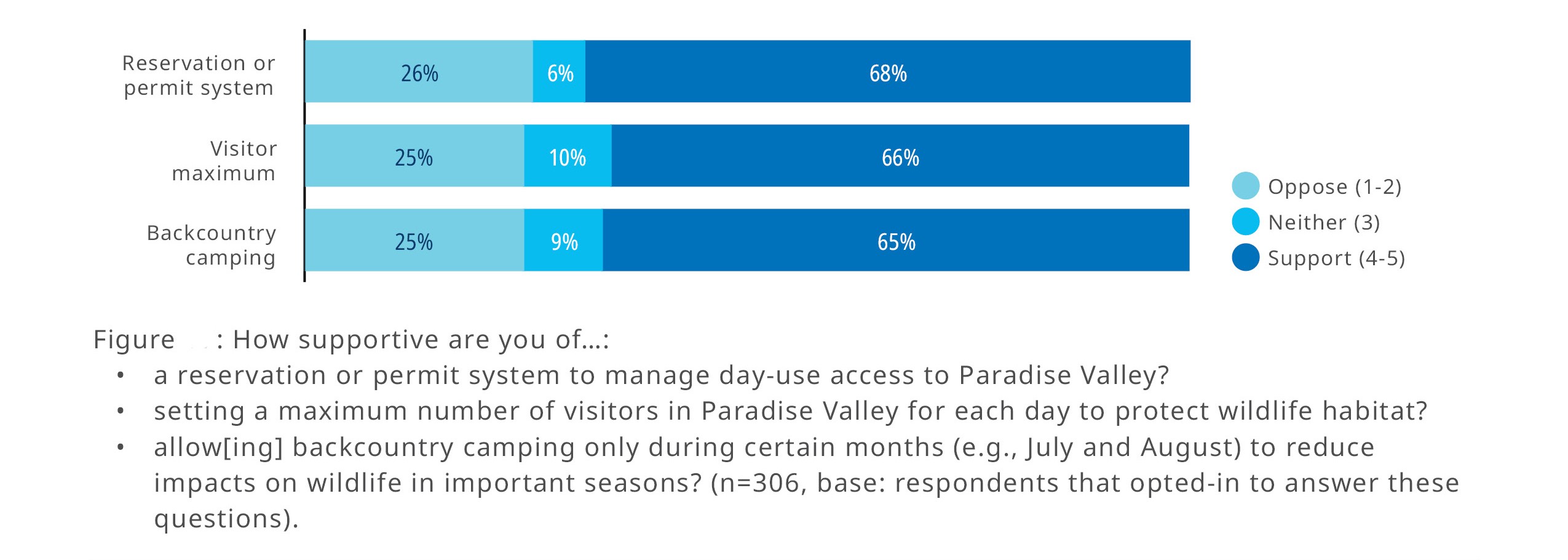
Figure 5: How supportive are you of…:
- a reservation or permit system to manage day-use access to Paradise Valley?
- setting a maximum number of visitors in Paradise Valley for each day to protect wildlife habitat?
- allow[ing] backcountry camping only during certain months (e.g., July and August) to reduce
- impacts on wildlife in important seasons? (n=306, base: respondents that opted-in to answer these questions).
Reservation or permit system
- Oppose (1-2) 26%
- Neither (3) 6%
- Support (4-5) 68%
Visitor maximum
- Oppose (1-2) 25%
- Neither (3) 10%
- Support (4-5) 66%
Backcountry camping
- Oppose (1-2) 25%
- Neither (3) 9%
- Support (4-5) 65%
Conclusion
Thank you to everyone who participated in this phase of public engagement for the Lake Louise Area Visitor Use Management Plan. Public feedback will be taken into account as Parks Canada assesses strategies and actions for viability, feasibility and desirability.
For details and project updates, please visit:
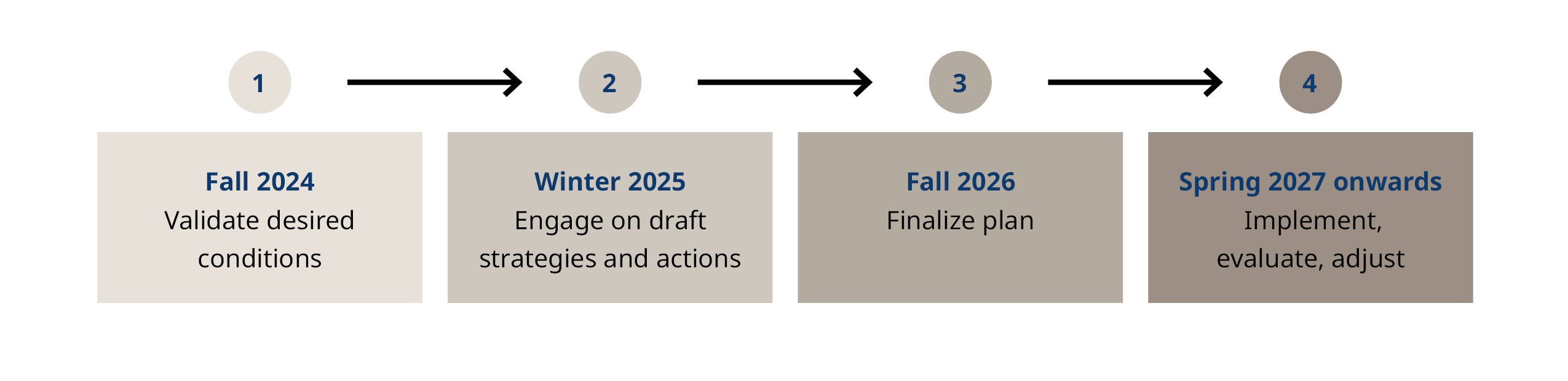
The remaining steps in the VUM Framework will be completed by Parks Canada in 2026 with the final Lake Louise Visitor Use Management Plan anticipated in fall 2026.